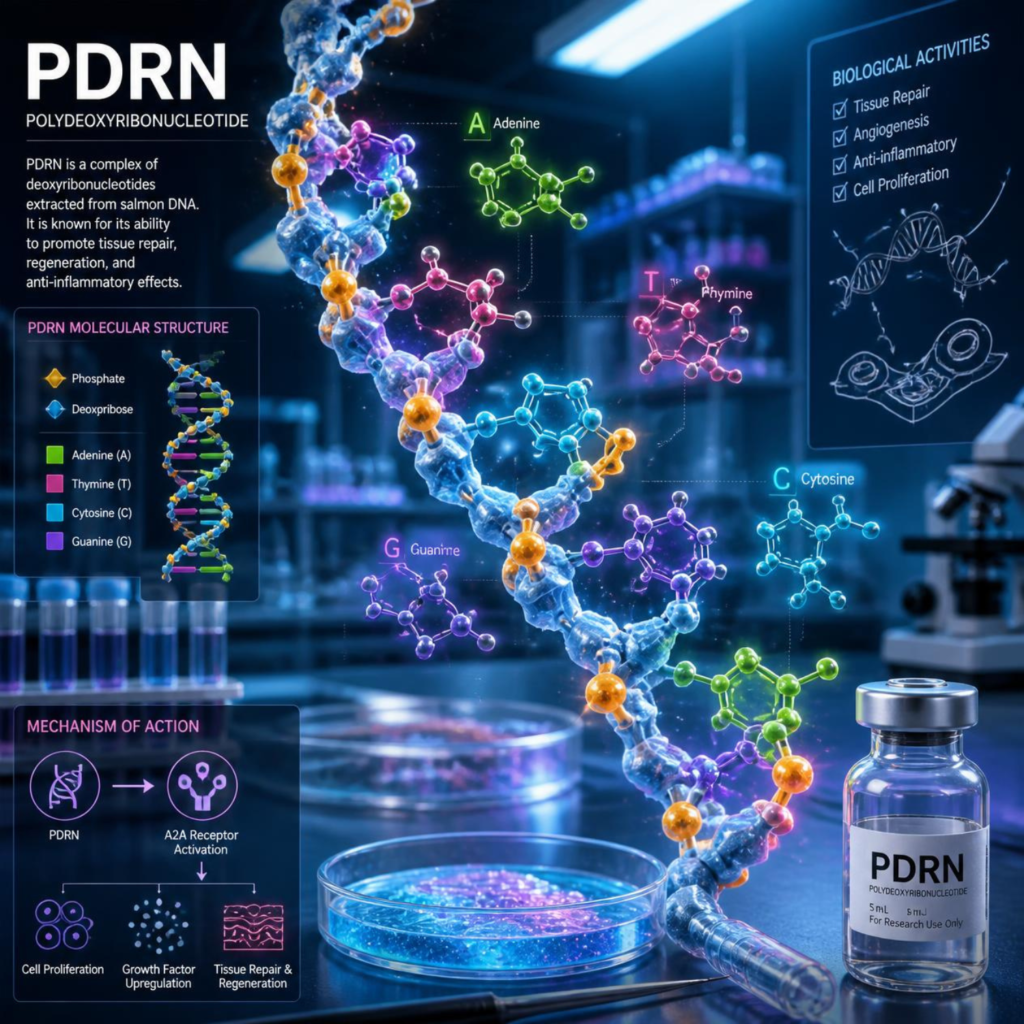
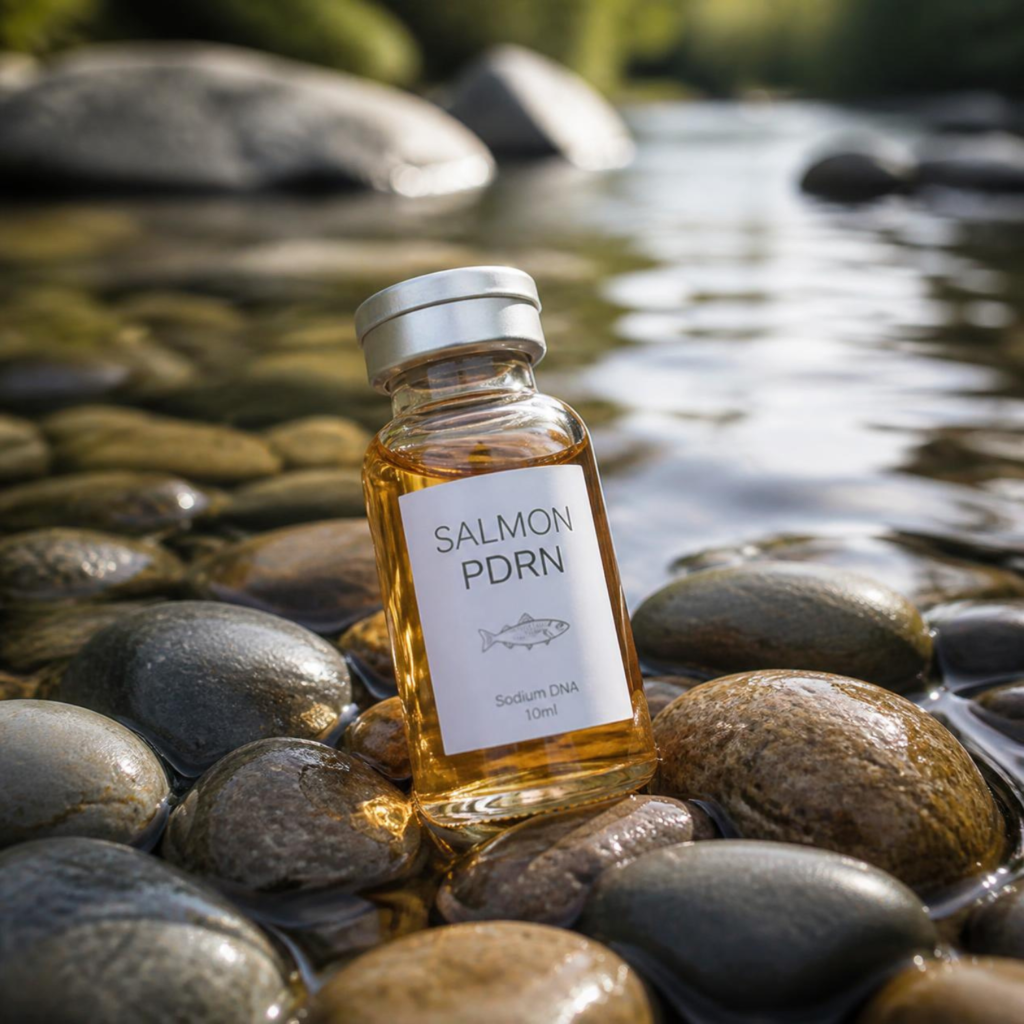
- A viral claim is going around: PDRN — K-beauty’s star “salmon DNA” ingredient — is too large to absorb topically, works only by injection, and is marketing overreach in a cream. The core of that claim is scientifically correct.
- The reason is molecular size. Standard salmon PDRN weighs around 132,000 Daltons, while intact skin generally blocks anything over ~500 Daltons. That’s roughly 264× too big to passively cross the barrier.
- But “it’s a total scam” goes too far. Topical PDRN can still hydrate and soothe at the surface, and 2025–2026 research on low-molecular-weight plant PDRN and encapsulated delivery is starting to change the picture.
- Bottom line: don’t buy a plain high-molecular-weight PDRN serum expecting injectable results. If you want topical PDRN, look for low-MW/plant PDRN, real delivery tech, or microneedle formats — and we’ll show you exactly what to check.

The PDRN controversy has become one of the biggest K-beauty skincare debates as more brands promote PDRN cosmetics with skin-repair, elasticity, and regeneration claims.
We’ve written a full PDRN ingredient guide before — what it is, why Korean derms love it, which products we rate. This post is the harder follow-up question that keeps landing in our DMs after a certain reel made the rounds:
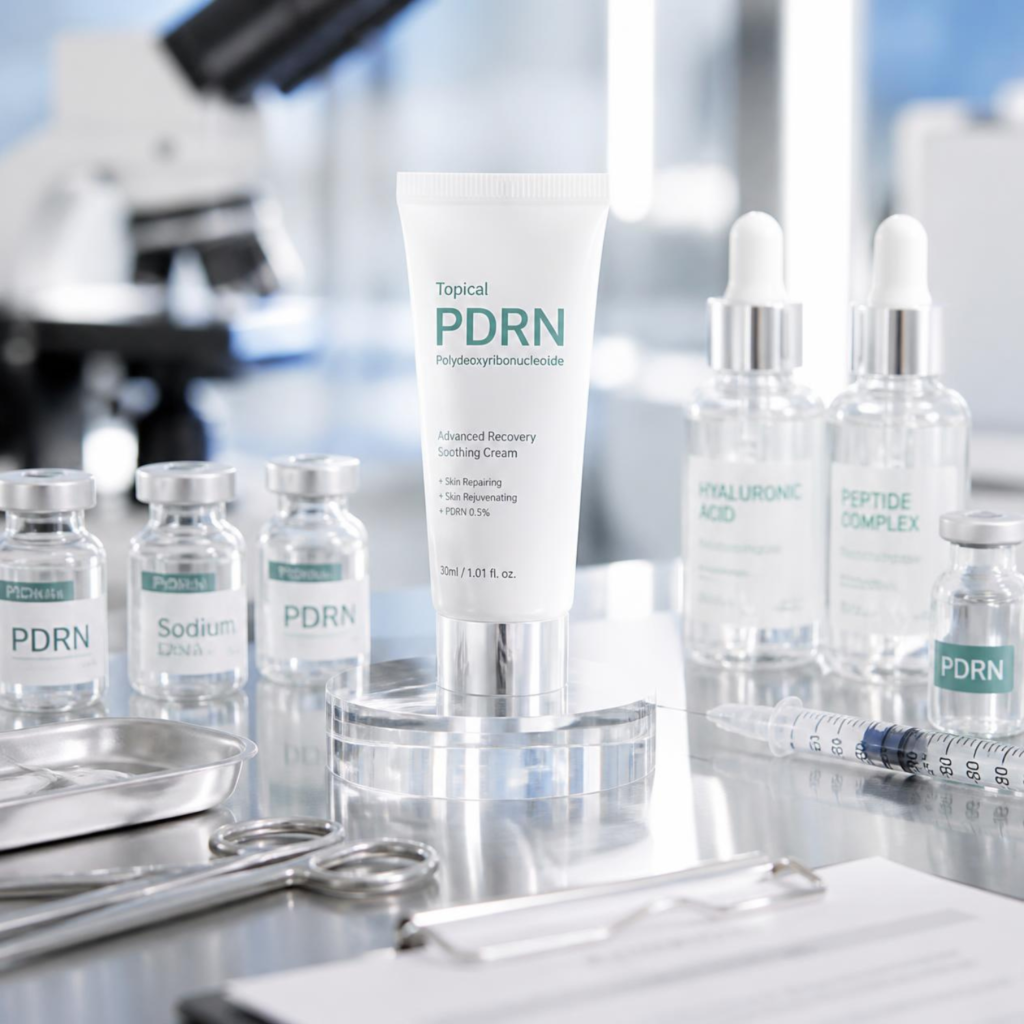
“If PDRN can’t even absorb, isn’t the whole cream category a scam?”
It’s a fair question, and it deserves a real answer rather than a defensive one. So we pulled the actual research. Here’s what holds up, what doesn’t, and what it means for where K-beauty goes next.
Quick Answer: Can Topical PDRN Absorb Into Skin?
The viral version goes like this: PDRN is a large DNA molecule, your skin barrier blocks large molecules, so a PDRN cream can’t deliver what the ads promise. The dramatic results come from injections, not serums.
Short answer: on the core science, the claim is right. Standard high-molecular-weight salmon PDRN does not meaningfully penetrate intact skin, and the impressive clinical results almost all come from injectable PDRN. Marketing that borrows those injection studies to sell a serum is, at best, leaving out the most important detail.
The nuance the viral version misses: “doesn’t absorb well” is not the same as “does literally nothing,” and the ingredient is evolving fast. Let’s break it down properly.
The Science: Why Molecular Size Decides Everything
Your skin’s outer layer — the stratum corneum — is a fortress designed to keep things out. Cosmetic chemistry has a well-known rule of thumb for what can cross it: the 500 Dalton rule. Coined in a widely cited 2000 dermatology paper, it states that molecules heavier than about 500 Daltons struggle to penetrate intact skin by passive diffusion. Almost all common topical drugs and allergens fall under that limit.
Now compare the numbers:
| Molecule | Approx. weight | Crosses intact skin? |
|---|---|---|
| Caffeine | ~194 Da | Yes, easily |
| Skin-penetration limit | ~500 Da | The threshold |
| Matrixyl (a peptide) | ~802 Da | Partially (barrier-smart design) |
| Salmon PDRN | ~132,000 Da | No — ~264× over the limit |
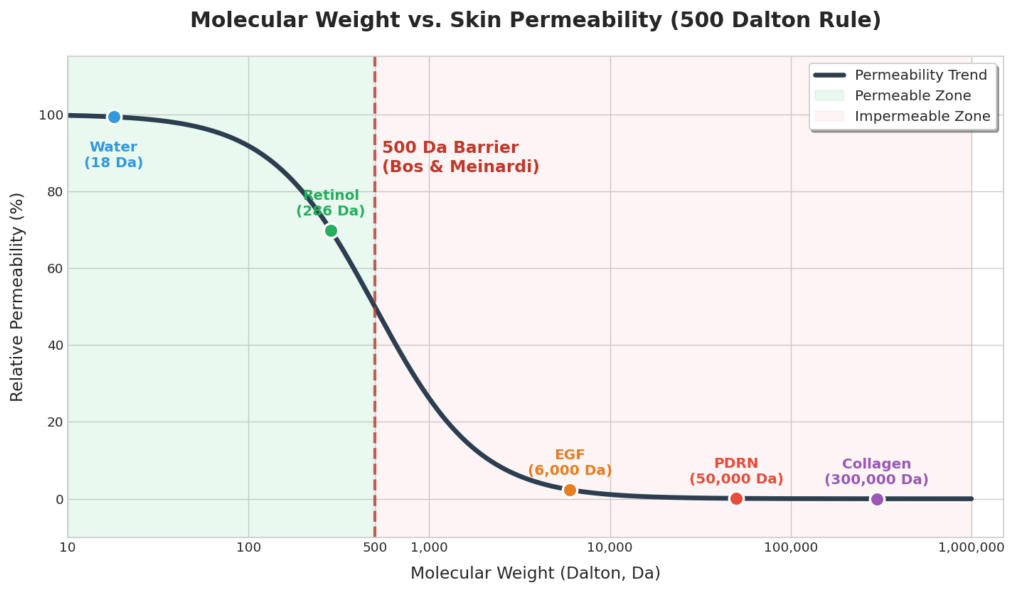
PDRN isn’t just a little over the line — it’s orders of magnitude past it. And the research reflects that.
When you look at the body of PDRN studies showing real regeneration, the overwhelming majority used injection, delivering PDRN directly into the dermis and bypassing the barrier entirely.
Studies of topical PDRN on intact skin have, until very recently, been essentially nonexistent — which is why even the scientific literature calls topical PDRN’s long-term efficacy “debatable.”

The industry has a blunt term for an expensive active that sits on the surface doing little: “angel dusting.” A pinch of a buzzy ingredient, just enough to put it on the label and the marketing.
Injectable PDRN vs Topical PDRN — Not the Same Product
| Factor | Injectable PDRN (e.g. Rejuran) | Standard topical PDRN serum |
|---|---|---|
| Delivery | Directly into the dermis | Sits on the skin surface |
| Skin barrier | Bypassed completely | Must cross it (mostly can’t) |
| Clinical evidence | Strong (many studies) | Very limited on intact skin |
| Administered by | A medical professional | You, at home |
| Realistic result | Regeneration, remodeling | Mostly surface hydration/soothing |
Here’s one simple question that cuts through all the marketing. When a brand shows off a PDRN “study” to sell you a serum, just ask:
“Was that study done with a cream — like the one I’m buying — or with an injection?” If it was an injection, the results don’t carry over to a serum. Simple as that.
So Is Topical PDRN a Scam? Not Exactly.
This is where we part ways with the harshest version of the viral take. “It doesn’t absorb, therefore it’s useless” overshoots the evidence in two ways.
1. Surface benefits are still real. Even if the PDRN molecule mostly stays up top, a well-made PDRN serum still hydrates, soothes, and supports the barrier — because of its humectant nature and the supporting ingredients around it.
That’s a legitimate (if unglamorous) benefit. It’s just not the collagen-remodeling, “filler in a bottle” story the ads imply.
2. Not all PDRN is the giant salmon version. The science is moving, and 2025–2026 brought genuine developments worth knowing.
What Changed: Low-MW Plant PDRN and Smarter Delivery
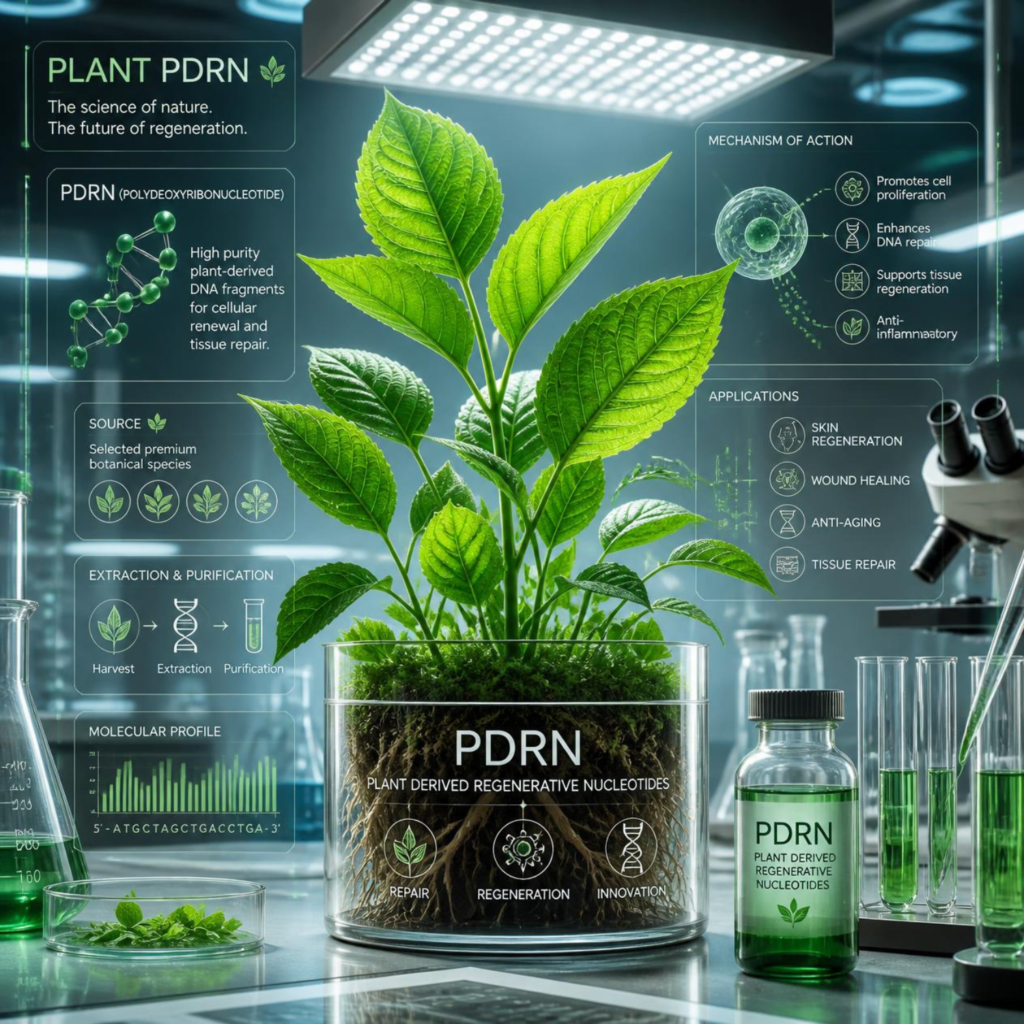
Tiny plant-based PDRN. Scientists have started making PDRN from plants instead of salmon — things like peony, snow lotus, microalgae, rice, and yeast.
The big deal? These versions are far smaller than the giant 132,000-Dalton salmon kind, so they have a much better shot at getting into your skin.
And there’s early proof. In a late-2025 study, a small “peony PDRN” improved firmness around the eyes after just four weeks of using it as a cream — the first time any topical PDRN has shown real results in a published study.
Another 2026 study found that PDRN from microalgae plumped and hydrated skin about as well as hyaluronic acid.
PDRN that’s “wrapped” to sneak in. Two more 2026 studies packed PDRN inside tiny carriers (called nanoparticles and exosomes) that helped it actually cross the skin barrier in lab tests. Translation: the absorption problem is real — but it might not be permanent.
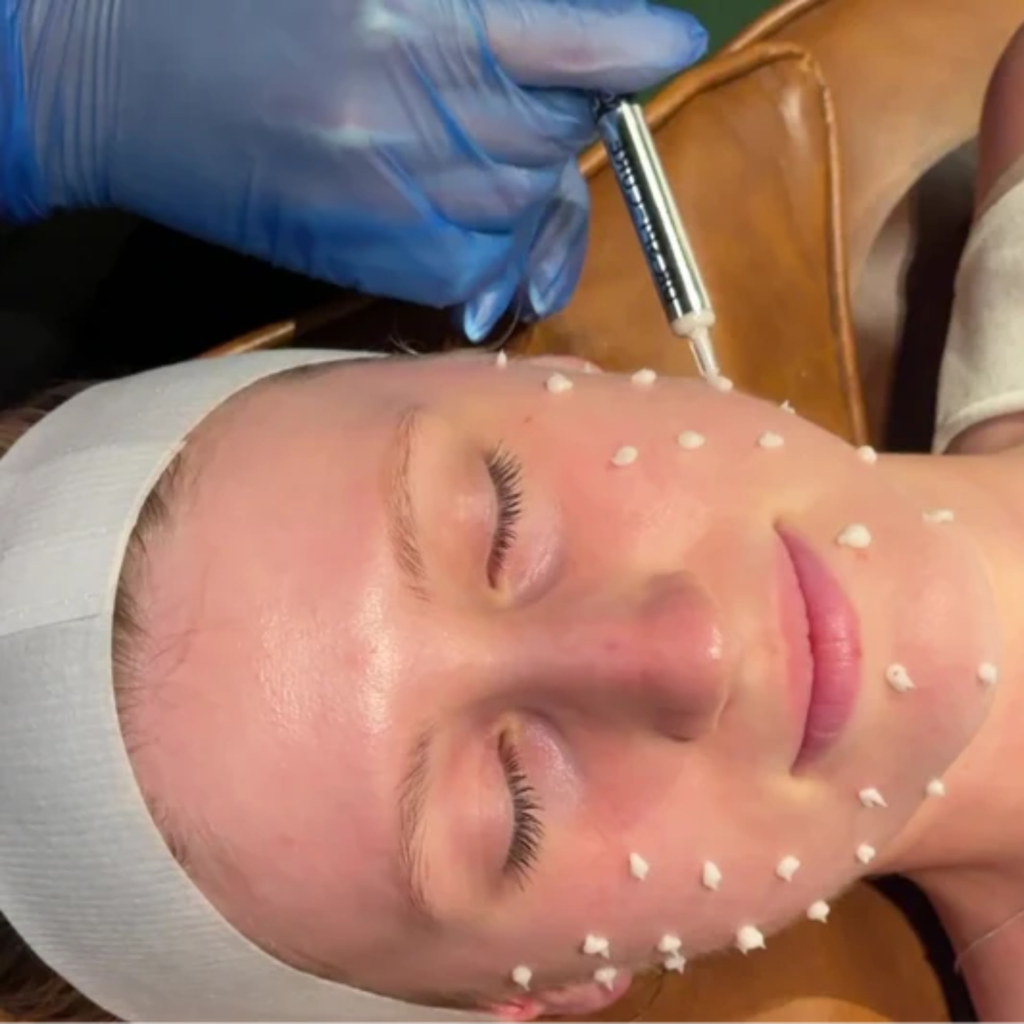
Microneedle formats. PDRN microneedle patches physically create micro-channels to deliver the molecule intradermally at home — a middle ground between a serum and a clinic injection (though these often sit in a regulatory gray zone between cosmetic and device).
⚠️ The catch: here’s the thing — almost none of this cool new science is actually in the PDRN serums you can buy right now at Sephora, Olive Young, or Amazon. Most of those still use the big, hard-to-absorb salmon PDRN with no special tech to help it sink in. The exciting stuff (tiny plant PDRN, encapsulation) is mostly still in labs and a few special products — not in your average pink PDRN box. So for most products on shelves today, the skeptics are right.
What to Buy — and What to Skip
You don’t need a chemistry degree to shop smarter. Use these filters.
Be skeptical of / skip:
- Plain “salmon PDRN” or “PN” serums and creams that promise injection-like results (“filler in a bottle,” “needle-free Rejuran”) with no delivery technology mentioned.
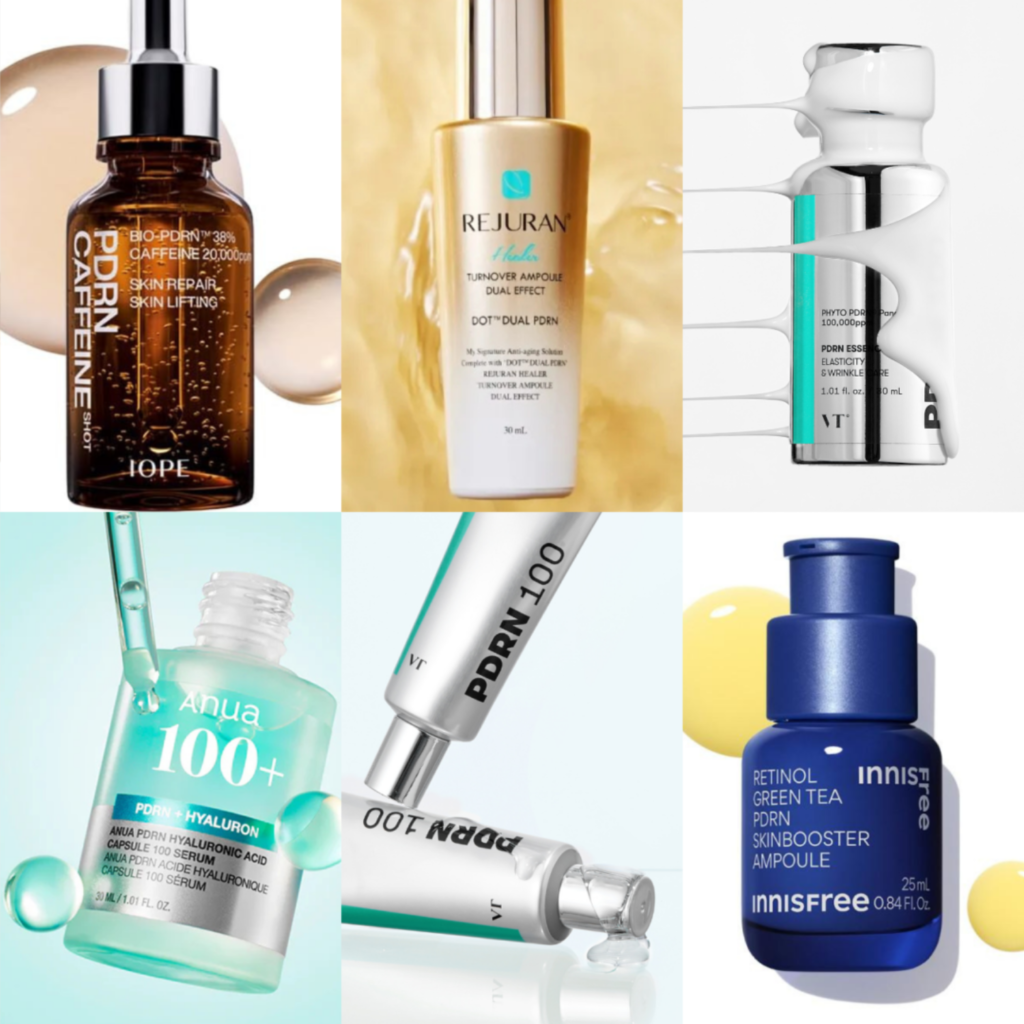
- Products whose “clinical proof” turns out to be injectable studies in the fine print.
- Anything relying on the ingredient name alone — PDRN high on the label, but nothing about how it gets in.
More defensible bets:
- Low-molecular-weight or plant/vegan PDRN (peony, microalgae, rice, yeast) — smaller molecules with at least some topical evidence.
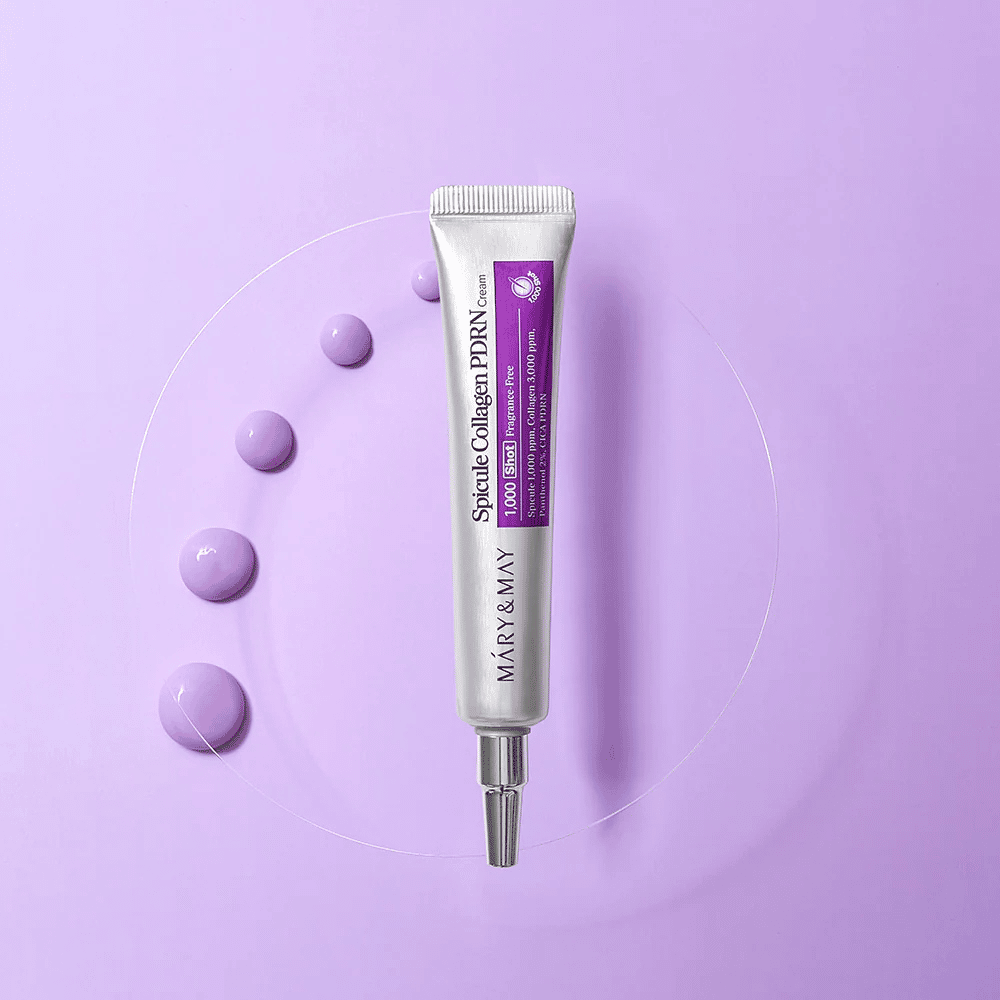
- Real delivery systems: liposomal or nano-encapsulated PDRN. Our PDRN guide highlights delivery-conscious formulas like Arencia’s liposome-based Booster Shot and Mary&May’s spicule (micro-channel) PDRN cream — approaches built around the absorption problem rather than ignoring it. (Still supportive skincare, not injection equivalents.)
- Products with published clinical data on that specific topical product — not borrowed injection studies.
- PDRN microneedle patches, or using a topical PDRN alongside (careful) microneedling, which compromises the barrier so more gets in.
- Want the proven version? That’s an in-clinic injectable PDRN treatment (like Rejuran). Honest, if not cheap.
And if collagen support is really your goal, remember topical PDRN isn’t your only option. Barrier-smart, topically-proven actives like peptides (e.g., Matrixyl) and niacinamide have better delivery evidence for at-home use — see our NAD+ guide and bakuchiol vs retinol comparison for gentler routes to the same goals.
The Bigger Picture: What This Means for K-Beauty
Here’s why this matters way beyond one ingredient. K-beauty is booming — bigger, more global, and more influential every year.
That success was built on real innovation: cushion foundations, sheet masks, snail mucin, cica, and PDRN itself. But the PDRN-serum debate is a warning sign of what happens when the marketing runs ahead of the science.
When a whole category grows on viral claims the evidence can’t back up, three things go wrong. Shoppers eventually feel tricked.
Trust — the thing that makes people believe “K-beauty works” — starts to crack. And the brands doing real, careful work get drowned out by whoever yells the trendiest ingredient the loudest.
The better path is the harder one: win on research and smart delivery, not just a buzzy ingredient name.
The brands making PDRN smaller, wrapping it so it actually absorbs, testing their own creams, and being honest about what a cream can and can’t do — those are the ones that deserve to lead K-beauty’s next decade. And as shoppers, the most powerful thing we can do is reward that honesty with our wallets.
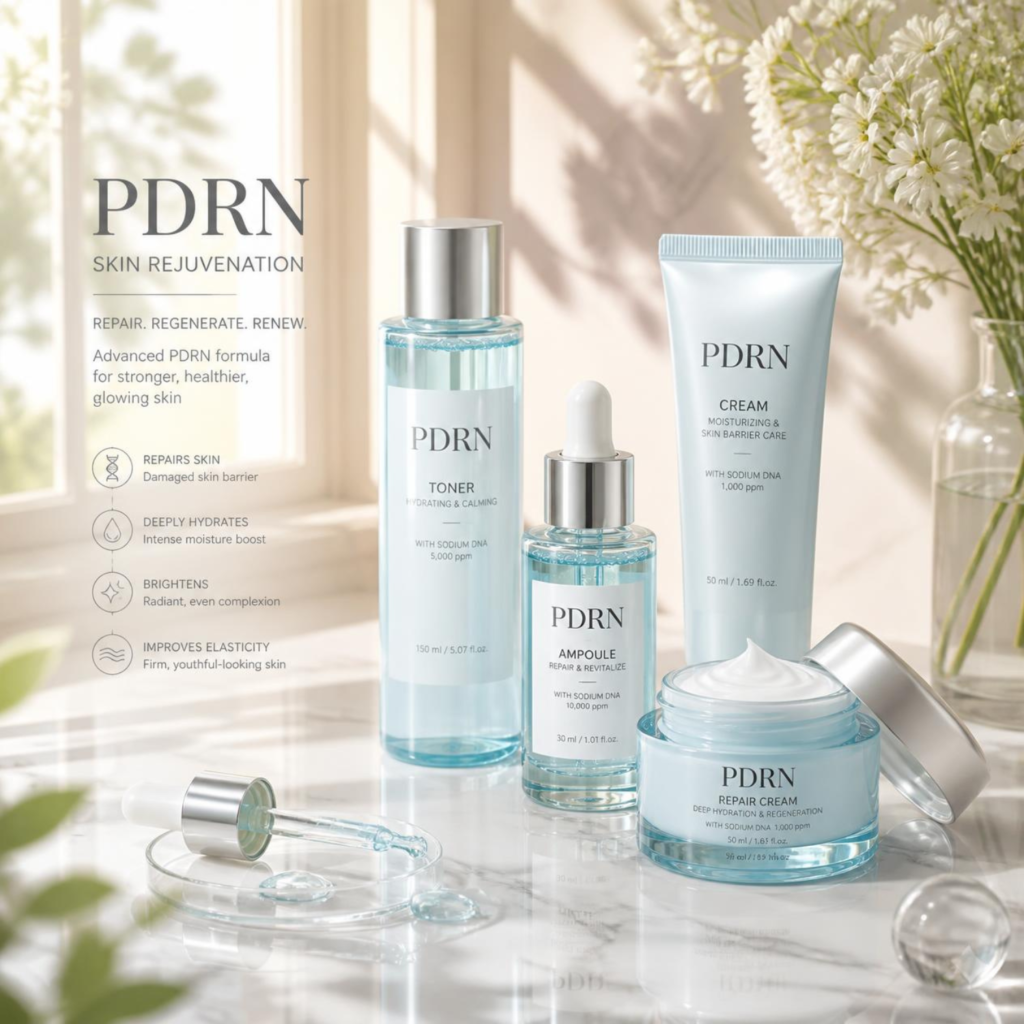
PDRN isn’t the villain here. Lazy marketing is. The ingredient has a real future in your skincare — but only through science, not slogans.
FAQ
Does topical PDRN actually absorb into the skin?
Standard high-molecular-weight salmon PDRN (around 132,000 Daltons) does not meaningfully penetrate intact skin, because it’s roughly 264 times larger than the ~500 Dalton limit for passive absorption.

It can hydrate and soothe at the surface, but it can’t deliver the deep results that injectable PDRN shows unless the barrier is compromised or advanced delivery technology is used.
Is PDRN skincare a scam?
No — it’s legitimate science that’s often misapplied. The mechanism and the injectable studies are real.
The problem is marketing that uses injection-based results to sell topical serums that can’t replicate them. That’s misleading rather than fraudulent, and a well-made PDRN product can still offer hydration and soothing benefits.
Why can’t PDRN penetrate the skin?
Because of its size. The stratum corneum generally blocks molecules heavier than about 500 Daltons.

Salmon PDRN is around 132,000 Daltons — orders of magnitude too large — so without a delivery system or a compromised barrier, it mostly sits on the surface.
What’s the difference between injectable and topical PDRN?
Injectable PDRN (such as Rejuran) is placed directly into the dermis, bypassing the barrier, and has strong clinical evidence. Topical PDRN must cross the barrier on its own, which standard salmon PDRN largely cannot. They are not equivalent treatments.
Is low-molecular-weight or vegan PDRN better for skincare?
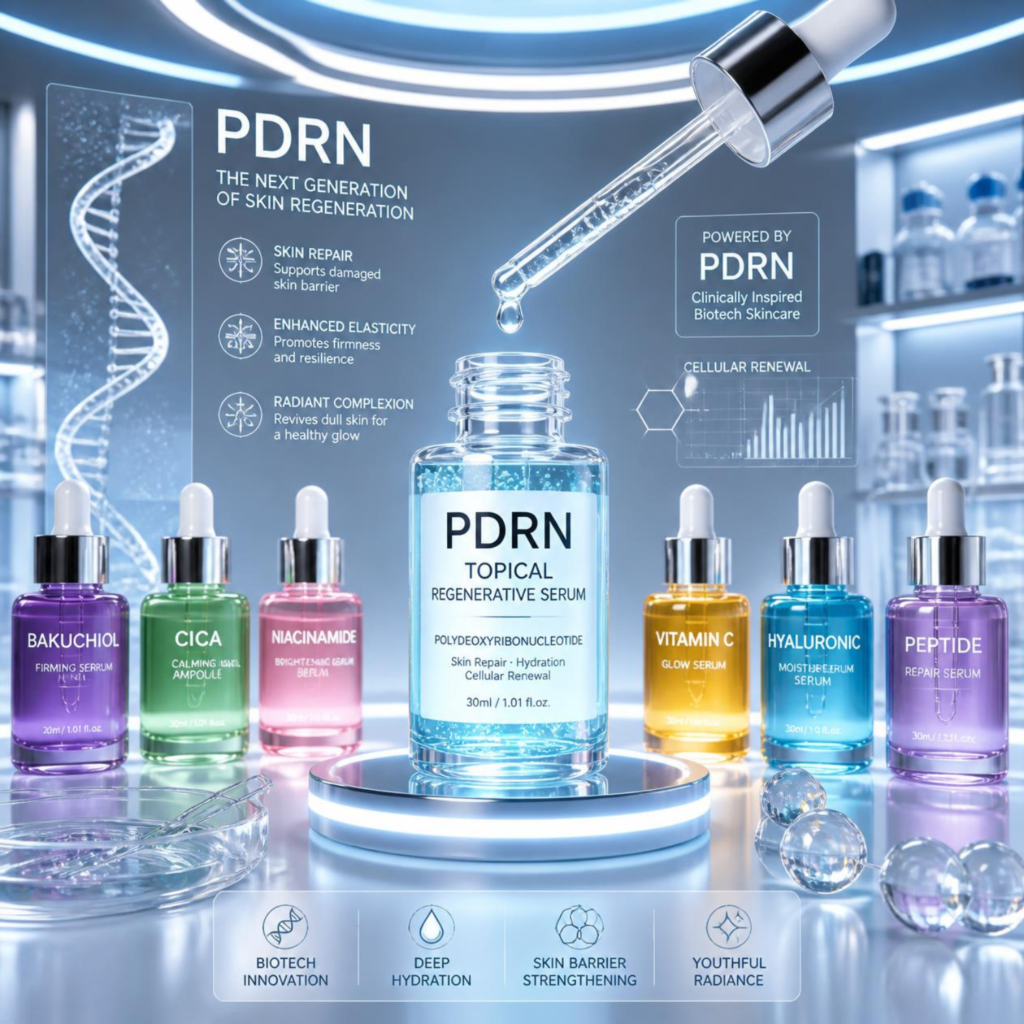
Potentially, yes. Plant-derived and low-MW PDRN (from peony, microalgae, rice, or yeast) is much smaller than salmon PDRN, and early 2025–2026 topical studies are more encouraging.
If you want a topical PDRN, low-MW or well-encapsulated versions are the more defensible choice.
What should I look for in a PDRN product?
Look for low-molecular-weight or plant PDRN, a stated delivery system (liposomal or nano-encapsulated), clinical data on the actual topical product, or a microneedle format.
Be skeptical of plain salmon-PDRN serums that promise injection-like results with no mention of how the molecule gets in.
Should I get PDRN injections instead?
If you specifically want the regeneration results seen in studies, in-clinic injectable PDRN is the evidence-backed route.

Topical PDRN is better understood as gentle, supportive maintenance — helpful for hydration and calm, not a needle replacement. Consult a licensed professional before any injectable treatment.
Related Reading
- PDRN Skincare Guide: Salmon DNA, Vegan PDRN & K-Beauty Products
- NAD+ Skincare in K-Beauty: Benefits, NAD vs NMN & Best Brands
- Bakuchiol vs Retinol and Recommended K-Beauty Products
- More K-Beauty Ingredient Guides from Yogi Korea
Final Word
So, does the PDRN in your serum absorb? For the typical high-molecular-weight salmon version sold today — no, not in the way the marketing implies. The viral claim gets the core science right, and that’s worth sitting with rather than brushing off.
But the honest, expert answer has a second half: topical PDRN still offers real surface benefits, and low-MW plant PDRN plus smart delivery is turning “it can’t work” into “here’s how it might.” The category isn’t fake — it’s just early, and too much of it is being sold on the promise of results that require a needle.
Shop by delivery, not by hype. Reward the brands doing the science. And if you want the clinically proven version of PDRN, that conversation belongs in a dermatologist’s office, not on a serum label.

What’s your take — have you tried a topical PDRN and felt a real difference, or does this match your suspicion? Tell us in the comments. 👇
This article analyzes published research and is for educational purposes only. It is not medical advice; consult a qualified dermatologist for treatment decisions. Ingredient claims reflect the state of the evidence at the time of writing.